
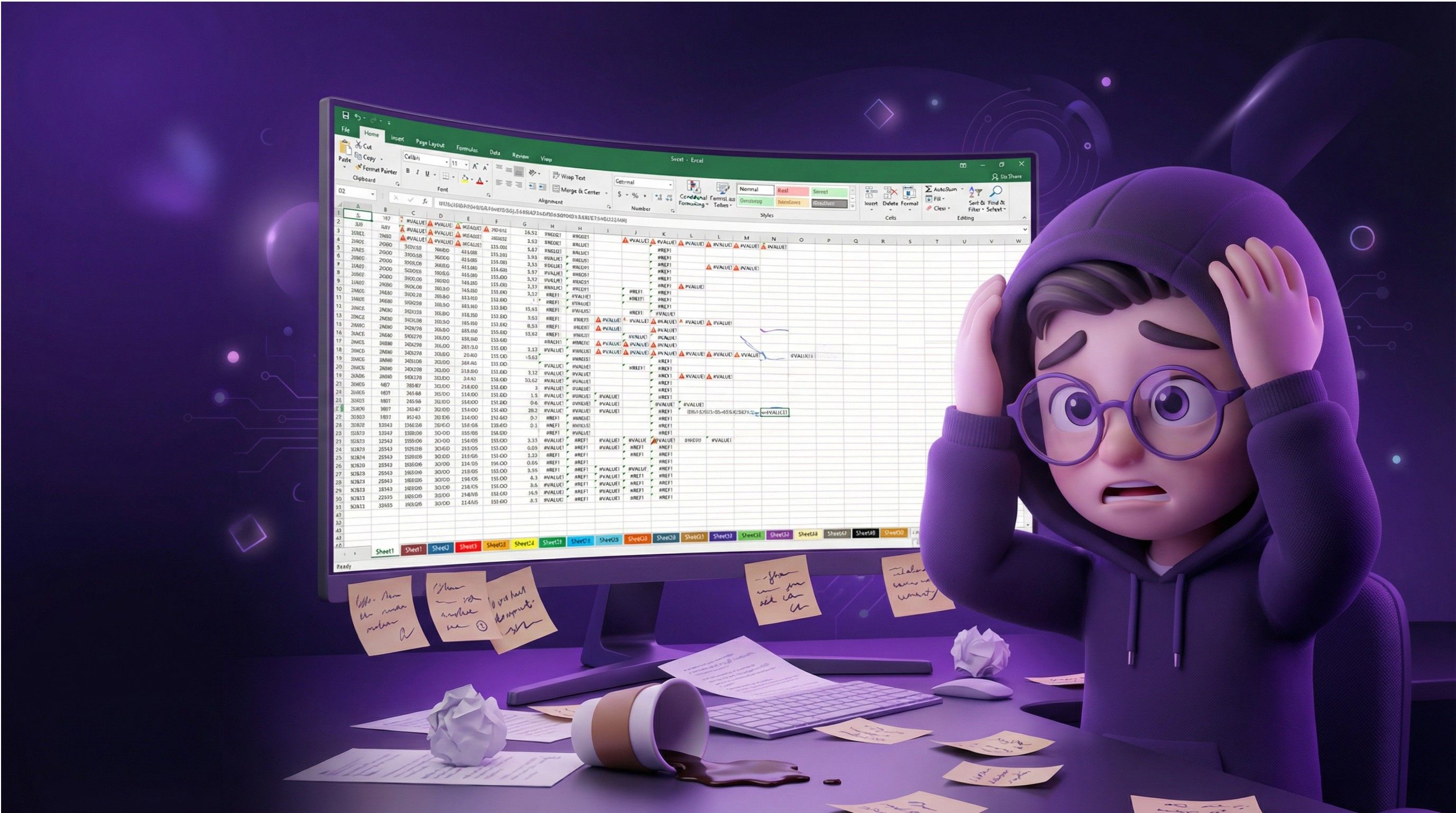
That file that was once your best friend is now a monster with 50 sheets, incomprehensible formulas, and data that never adds up. It slows down your PC, creates errors, and wastes hours of your time every week. If this description sounds familiar, you're not alone. Countless SMEs rely on Excel to manage crucial processes, but there comes a time when this tool, despite being flexible, becomes a handbrake on growth.
1. The "Monster" with 50 sheets: when the file becomes unmanageable
The first, unmistakable sign is complexity. Your Excel file has become a maze of interconnected sheets, with formulas that only you (maybe) understand. Every new row is a risk, every change a potential catastrophe. You spend more time trying not to break the file than using it to get useful information. This is no longer a work tool, it's a source of stress.
2. Human error is always lurking
A mistyped number, an incorrectly copied formula, an accidentally deleted row. With Excel, human error isn't an exception, it's a statistical certainty. And when the data is wrong, the decisions you make based on that data are wrong. How many times have you discovered an error in a report only after presenting it to your team or, worse, to a client? A custom management system eliminates this risk at its source, automating data entry and validating it in real-time.
3. You never know which is the right version of the file
"Revenue_2026_v3_FINAL_FINAL_CORRECTED.xlsx". Sound familiar? When multiple people work on the same Excel file, version chaos is inevitable. Who has the latest version? What changes have been made? Has someone overwritten someone else's work? These questions shouldn't exist in a modern company. A centralized management system ensures that everyone works on the same data, always up-to-date, without version conflicts and with complete traceability of every change.
4. Data isn't real-time (and decisions are wrong)
Excel is a static tool. The data it contains is a snapshot of a past moment. To have updated information, someone must enter it manually. This means your decisions are based on data that's hours, days, or in the worst case, weeks old. A custom management system, on the other hand, feeds on real-time data from all business sources (orders, inventory, accounting, CRM). You always have a clear and updated view of your company's status, and you can make informed and timely decisions.
5. Your team spends more time entering data than working
This is perhaps the most painful sign. Look at your team: how many hours per week do they spend entering data into Excel sheets, copying it from one sheet to another, creating manual reports? All this time is time taken away from higher-value activities, like talking to customers, developing new products, or improving processes. A custom management system automates repetitive tasks and unleashes people's potential.
The solution: a custom management system. Not a cost, an investment.
If you recognized yourself in at least two of these signs, it's time to take a step forward. Moving from Excel to a custom management system isn't a cost, it's an investment that pays for itself quickly thanks to increased efficiency, reduced errors, and time freed up for your team. At Selli, we specialize in creating custom management systems for SMEs. We won't propose a standard software with a thousand useless features, but a tailored solution, crafted to fit your processes and needs. Contact us for a free consultation: we'll analyze your situation together and show you how saying goodbye to Excel (and its limitations) can be the first step toward more solid and peaceful growth.